
The South Slave Research Centre (SSRC), located at the Thebacha Campus of Aurora College in Fort Smith, was established in 1991 to support research and community engagement in the South Slave region. SSRC has a small but passionate team that believes that the NWT’s collective capacity can be increased through collaborative research.
SSRC works with local Indigenous governments and other community organizations to create opportunities that will support their priorities, which can include, for example, sustainable food security or climate change initiatives. Part of the role of SSRC also includes working with fellow researchers from southern Canada who share our commitment to making a difference.
Over the last several years, we have been working to raise the importance of food security and food sovereignty in a changing climate. People in Fort Smith express concern about how food from the land is changing. Some of those concerns include berries becoming scarcer, forest habitats being impacted by fire, and low water levels affecting fish. They also worry about the rising cost of food and low quality of produce, and our over-dependence on one road to supply trucked-in food.
In recent years, SSRC has been involved with working among 11 regional groups worked to build a collaborative framework through a project called the Boreal Berry Patch Collective. Funded by Indigenous Services Canada’s Climate Change Health Adaptation Program, collective aims to meet the long-term goal of improving food security. The project has involved planting lots of berries in the community and more than 250 berry shrubs and fruit trees. Additionally, the collective has carried out over numerous workshops and events aimed at promoting food self-sufficiency.
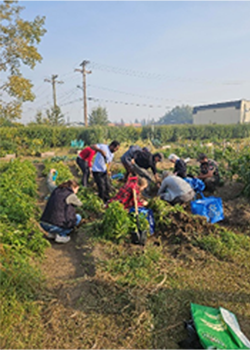
This recent work has many positive returns that have generated additional spin-off projects and partnerships. For example, over the last two years, the Fort Smith Community Garden has become a site for workshops, research, and a place to build community involvement around improving local food. In 2025, a Food Bank Plot was started to give back to the community. That project led to attracting citizen volunteers who help maintain the plot.
Strawberries and other crop growth
Other collaborative research projects have also borne fruit in the region! In 2024, SSRC developed a project with Sambaa K’e First Nation First Nation (Trout Lake) and Northern Roots Consulting (Yellowknife) to gather data around best practices for growing strawberries in the NWT. Trials continued at the community garden in 2025, and it is hoped that this type of research will lead to the study of other ‘novel crops’ that may be able to thrive in a changing climate.
To that end, SSRC is working on a proposal to expand research that will build knowledge on best practices for growing food in cold climate greenhouses and perennial crop production.
Looking ahead, SSRC is excited to be working with the Future Harvest Partnership, a multi-year project that was developed to carry out research to build climate-resilient local food systems in the Northwest Territories. A collaboration between Wilfrid Laurier University, the Territorial Agrifood Association and the Government of the NWT Department of Industry, Tourism, and Investment that is funded through Social Sciences and Humanities Research Council (SSHRC), the Future Harvest Partnership is supporting important food security research, including food systems planning with Indigenous governments and community organizations.