Search

Suncor Energy Foundation provides $602,500 to Aurora College Funds will support and strengthen STEM education across NWT

La version française suit le texte anglais.

FOR IMMEDIATE RELEASE

May 3, 2024

Suncor Energy Foundation provides $602,500 to Aurora College

Funds will support and strengthen STEM education across NWT

INUVIK, NT – Aurora College has received $602,500 from Suncor Energy Foundation to support the Aurora Research Institute’s Science, Technology, Engineering, and Math (ARI STEM) Outreach Team for the next four years.

The STEM programming includes exposure to traditional sciences such as chemistry and physics, workshops designed to enhance coding and digital literacy, and coding camps.

The financial support from the Suncor Energy Foundation will help meet the growing demand for STEM education across the Northwest Territories. Programming will focus on youth in small communities, providing educational opportunities that promote the importance of STEM education.

In 2023, the ARI STEM outreach team received the NWT Premier’s for their work expanding STEM outreach across the territory. In 2022-2023, the team hosted more than 450 hands-on science and digital literacy events, reaching in excess of 8,500 students. They also hosted three regional science fairs and initiated a “train the teacher, loan the gear” program. The program trained teachers how to integrate STEM into their classrooms with specially-created loaner kits, many of which are designed to appeal to northern students and are based on northern themes.

Since 2016, the ARI STEM outreach team has delivered hands-on STEM outreach programs and education across 21 communities for youth and adults, primarily operating out of Aurora College’s research centres in Inuvik, Fort Smith and Yellowknife.

Quotes:

 “We take great pride in the achievements of our STEM Outreach Team across the region and territory. The substantial support from the Suncor Energy Foundation not only underscores their commitment but also empowers our teams to further excel in providing exceptional education and mentorship. By engaging young students in the North with hands-on learning experiences and reinforcing cultural values, we are shaping a brighter future throughout the Northwest Territories.”
– Joel McAlister, Vice President of Research, Aurora Research Institute

— 30 —

Aurora College delivers academic upgrading, trades and industrial training, certificate, diploma and degree programs to students at three campuses, 19 Community Learning Centres and other community sites in the Northwest Territories. Community-centred post-secondary programs reflect Northern culture and the needs of the Northern labour market. Aurora College’s research division, Aurora Research Institute, conducts and supports research in the NWT. Research centres are located in Inuvik, Yellowknife and Fort Smith.

For more information, please contact:

Jayne Murray                                                                           

Manager, Communications & College Relations 

Aurora College                                                             

Phone: 867-872-7021 

Email: jmurray@auroracollege.nt.ca


POUR DIFFUSION IMMÉDIATE

3 mai 2024

La Fondation Suncor Énergie verse 602 500 $ au Collège Aurora.

Ces fonds visent à soutenir les programmes des STIM aux TNO.

Inuvik, TNO – Le Collège Aurora a reçu 602 500 $ de la Fondation Suncor Énergie afin de soutenir l’équipe de promotion des STIM (sciences, technologie, ingénierie et mathématiques) de l’Institut de recherche Aurora (IRA).

Les programmes des STIM incluent l’introduction à des sciences traditionnelles comme la chimie et la physique ainsi que des ateliers consacrés aux technologies numériques et au codage informatique.

Le soutien financier de la Fondation Suncor Énergie permettra de répondre à la demande croissante en matière d’enseignement des STIM aux Territoires du Nord-Ouest. Les programmes seront axés sur les jeunes des petites collectivités et offriront des occasions de promouvoir l’importance de l’éducation en matière de STIM.

En 2023, l’équipe de promotion des STIM de l’IRA a reçu le prix du premier ministre des TNO pour son travail de développement de la promotion des STIM dans l’ensemble du territoire. En 2022-2023, l’équipe a organisé plus de 450 événements pratiques axés sur les sciences et la culture numérique, ce qui lui a permis de s’adresser à plus de 8 500 élèves. Cette équipe a également organisé trois foires scientifiques régionales et a lancé un programme « Former l’enseignant, prêter l’équipement ». Ce programme a permis de former les enseignants à l’intégration des STIM dans leurs classes à l’aide de trousses d’emprunt, dont plusieurs sont conçues pour plaire aux élèves du Nord et sont inspirées de thèmes nordiques.

Depuis 2016, l’équipe de promotion des STIM de l’IRA a mis en œuvre des programmes pratiques dans 21 collectivités pour les jeunes et les adultes, principalement à partir des centres de recherche du Collège Aurora à Inuvik, à Fort Smith et à Yellowknife.

Citation

«Nous sommes très fiers des réalisations de notre équipe de promotion des STIM dans l’ensemble de la région et du territoire. Le soutien important de la Fondation Suncor Énergie souligne non seulement leur engagement, mais permet également à nos équipes d’exceller davantage pour offrir un enseignement et un mentorat exceptionnels. En proposant aux jeunes étudiants du Nord des expériences d’apprentissage pratiques et en renforçant les valeurs culturelles, nous façonnons un avenir meilleur dans l’ensemble des Territoires du Nord-Ouest.»
– Joel McAlister, vice-président à la recherche de l’Institut de recherche Aurora

— 30 —

Le Collège Aurora donne des cours de perfectionnement scolaires et des formations aux métiers et dans les domaines techniques par l’intermédiaire de programmes postsecondaires menant à un certificat ou à un diplôme dans trois campus, 19 centres d’apprentissage communautaires et d’autres établissements communautaires des Territoires du Nord-Ouest. Les programmes postsecondaires axés sur la collectivité reflètent la culture du Nord et les besoins du marché du travail dans le Nord. La division de la recherche du Collège Aurora, appelée Institut de recherche Aurora, mène et soutient les recherches aux TNO. Les centres de recherche sont situés à Inuvik, à Yellowknife et à Fort Smith.

Pour en savoir plus, communiquez avec :

Jayne Murray                                                                           

Gestionnaire des communications et des relations du Collège    

Collège Aurora                                                             

Téléphone : 867-872-7021

Courriel : jmurray@auroracollege.nt.ca
Research Advisory Council

The Aurora Research Institute (ARI) of Aurora College is seeking an external member for the Research Advisory Council (RAC), a standing committee of the Aurora College Board of Governors.

The RAC guides Aurora College and ARI in the pursuit of research-related goals and objectives, as described in the ARI strategic plan. To accomplish this, the RAC provides advice on College research priorities, guides the development and growth of research capacity at ARI and the College, and provides overarching strategic guidance on research-related initiatives.

The RAC is composed of several internal Board members, and four external members with NWT-based research expertise in specific academic disciplines. We are currently seeking the following external member: Social Sciences Representative – This external member provides expertise and guidance on research in the social sciences. The successful candidate will have extensive experience conducting social research in the NWT, and a proven record of securing competitive research funding (e.g. from the Social Sciences and Humanities Research Council of Canada, or similar agencies).

If you would like to apply for this opportunity, please submit a CV and cover letter outlining your research background and suitability by Friday, May 10, 2024.

Applications and questions should be directed to:

Aurora College Board of Governors
c/o Heather Meacock and April Davies
Executive Assistant to the President, Aurora College
PO Box 1290
Fort Smith, NT X0E 0P0
Phone: 867-872-7009 Fax: 867-872-5143
Email: hmeacock@auroracollege.nt.ca
adavies@auroracollege.nt.ca


L’Institut de recherche Aurora (IRA) du Collège Aurora est à la recherche d’un membre externe pour siéger au Conseil consultatif de recherche (CCR), un comité permanent du Conseil des gouverneurs du Collège.

Le CCR guide le Collège et l’IRA dans la réalisation des buts et des objectifs associés à la recherche, comme exprimés dans le plan stratégique de l’IRA. Pour ce faire, le CCR formule des conseils sur les priorités de recherche du Collège, éclaire le développement et la croissance de la capacité de recherche de l’IRA et du Collège, et définit l’orientation stratégique générale des initiatives de recherche.

Le CCR est composé de plusieurs membres internes du conseil d’administration et de quatre membres externes forts d’une expertise propre aux TNO dans une discipline universitaire précise. Nous sommes actuellement à la recherche d’un membre externe qui agira à titre de représentant pour le domaine suivant:

Sciences sociales : Le membre externe fournit conseils et orientation sur la recherche en sciences sociales. Le candidat retenu devra posséder une expérience approfondie en recherche en sciences sociales aux TNO et des habiletés éprouvées dans l’obtention de fonds de recherche obtenus par voie de concours (du Conseil de recherches en sciences humaines, par exemple, ou d’autres organismes).

Si vous souhaitez offrir vos services, veuillez soumettre votre curriculum vitæ et une lettre d’accompagnement qui précise vos antécédents en recherche ainsi que les raisons qui font de vous un excellent candidat pour ce poste avant le 01 mai 2024.

Veuillez adresser vos questions et votre dossier de candidature au :

Conseil des gouverneurs du Collège Aurora
a/s Heather Meacock et April Davies
Adjointe administrative du président du Collège Aurora
C. P. 1290 Fort Smith NT X0E 0P0
Téléphone : 867-872-7009 Télécopieur : 867-872-5143
Adresse courriel: hmeacock@auroracollege.nt.ca
adavies@auroracollege.nt.ca

Research Ethics Committee – External Member

Call for Expressions of Interest

Aurora College is seeking individuals to serve as community members on its Research Ethics Committee (REC). The community members should be residents of the Northwest Territories and should not be currently enrolled students or employees of Aurora College. The successful candidate will be named to the committee for a three year term.

The Aurora College REC is established and empowered under the authority of Aurora College. The REC reviews research proposals from researchers conducting their research in the NWT to ensure that the research adheres to the highest ethical standard set out by the Tri-Council Policy Statement on Ethical Conduct of Research Involving Humans (TCPS).

The Research Ethics Committee meets monthly, for a two hour meeting via MS Teams or teleconference to review research applications and has one face-to-face meeting/training session annually. Committee members also participate in delegated reviews and interim meetings throughout the year, as needed.

Previous experience as research participants, or working on committees is desirable but not essential. Interested members will be provided with ethics educational opportunities. Participating community members will receive an honorarium with appropriate tax deduction according to GNWT policy.

If you have any questions regarding role and responsibilities of the Research Ethics Committee members please contact:

Sunila R. Kalkar
Manager, Research Ethics & Regional Programs
Phone: 867-872-7084
Email: SKalkar@auroracollege.nt.ca

If you are interested in applying for this opportunity, please submit your resume and a letter of interest to sit as a member of the Research Ethics Committee by Friday, March 1, 2024 to:

April Davies
Executive Assistant to the President
Office of the President, Aurora College
PO Box 1290
Fort Smith, NT X0E 0P0
Phone: 867-872-7009
Fax: 867-872-5143
Email: ADavies@auroracollege.nt.ca


Aurora Research Institute STEM Outreach Team Wins 2023 Premier’s Award

Aurora College is proud to announce that its Aurora Research Institute (ARI) STEM Outreach team has received the 2023 Premier’s Award in the Teams category for their exceptional work providing experiential Science, Technology, Engineering and Math education to youth and educators  across the Northwest Territories. The ARI STEM Outreach team has displayed innovation, creativity, service excellence, and a commitment to embracing inclusion and Traditional Knowledge in their work since 2016.

Each year, the Premier of the Northwest Territories recognizes GNWT employees and teams that demonstrate excellence, innovation, and dedication through the Premier’s Awards.

During the past year, the STEM Outreach team has delivered more than 500 hands-on STEM events, engaging NWT youth nearly 10,000 times, in more than 25 communities across five regions. They have successfully mentored hundreds of NWT teachers, providing them with the skills and tools necessary to make STEM programming in their classrooms more hands-on and inquiry-driven. This has created a sustainable approach to expanding STEM educational opportunities, ultimately working towards improving employment and economic opportunities.

The team has received national recognition for their dedication to excellence, winning several prestigious awards. Their partnerships with regional school boards, Aurora College instructors and national organizations such as Actua, Let’s Talk Science, Polar Knowledge Canada and the Natural Sciences and Engineering Research Council of Canada (NSERC) have enabled them to develop and deliver innovative and culturally appropriate programs, directly addressing the unique needs of Northern students and educators.

Committed to incorporating Indigenous Traditional Knowledge and northern settings into their programming, Outreach team has garnered support from Indigenous organizations, including the Gwich’in Tribal Council and the Inuvialuit Regional Corporation. Engaging students on the land, inviting Elders to share their knowledge, and establishing projects such as the ethnobotany educational garden in Inuvik have significantly contributed to promoting STEM education in a culturally relevant way.

Quotes:

“We are proud of the accomplishments our STEM Outreach Team has achieved regionally and territorially.  The education and mentorship of students and teachers ignites experiential learning and affirms cultural values – a sharing that empowers the relevance of learning throughout the regions in the NWT.
–              Joel McAlister, Vice President Research, Aurora College

Research seeks to increase number of Indigenous youth in healthcare professions

La version française suit le texte anglais.

Aurora College has been awarded $150,000 from the Canadian Institutes of Health Research (CIHR) to examine strategies to address the current healthcare and social services workforce crisis and encourage more Indigenous and Northern youth to pursue careers in healthcare.

The CIHR Catalyst Grant for Policy Research for Health System Transformation will support the project entitled “Spark the Fire: Policy Strategy for Retention and Support of Indigenous and Northern Youths’ Pursuit of Healthcare Careers in the Northwest Territories”. A total of 22 northern researchers will be involved in the project. (See attached list)

According to the 2016 Statistics Canada Census, slightly more than half of the NWT population is Indigenous, yet Indigenous persons are significantly under-represented in healthcare and social services professions. In addition, the Northwest Territories Health and Social Services Authority notes as of June 30, 2022, the vacancy rate for healthcare professionals in the NWT was 26 percent. Most NWT communities continue to struggle with a high turnover of healthcare workers, limited recruitment success and overburdened healthcare providers.

The project will include all regions of NWT, with the support of community leaders, Indigenous Elders and various stakeholder groups. It will engage with Indigenous and Northern youth in grades 9-12 to identify local strengths and barriers to pursuing healthcare and social services careers. The resulting evidence-based strategy will be rooted in Indigenous and Northern perspectives, using the philosophical framework “Strong Like Two People”.

The CIHR Catalyst Grant will advance evidence-informed policy options, solutions and strategies to address the NWT’s current health workforce crisis. By nurturing a regionally grown healthcare workforce, “Spark the Fire” seeks to contribute to recruitment and retention initiatives, promoting a more diverse, culturally safe and accessible healthcare system for all residents.

Projet de recherche visant à augmenter le nombre de jeunes autochtones dans les professions de la santé

YELLOWKNIFE, TNO – Le Collège Aurora a reçu 150 000 $ des Instituts de recherche en santé du Canada (IRSC) pour examiner des stratégies visant à pallier la pénurie actuelle de main-d’œuvre dans le secteur des soins de santé et des services sociaux et à encourager un plus grand nombre de jeunes autochtones et du Nord à poursuivre des carrières dans le domaine de la santé.

La subvention Catalyseur pour la recherche sur les politiques pour la transformation du système de santé des IRSC soutiendra le projet « Allumer la flamme : Stratégie politique pour la rétention et le soutien des jeunes autochtones et du Nord dans la poursuite de carrières dans le domaine de la santé aux Territoires du Nord-Ouest. » Au total, 22 spécialistes de la recherche nordique participeront au projet. (Voir la liste jointe)

Selon le recensement de 2016 de Statistique Canada, un peu plus de la moitié de la population des Territoires du Nord‑Ouest (TNO) est autochtone. Toutefois, les Autochtones sont largement sous‑représentés dans les professions de la santé et des services sociaux. Par ailleurs, l’Administration des services de santé et des services sociaux des Territoires du Nord-Ouest a constaté qu’au 30 juin 2022, le taux de postes vacants de professionnels de la santé aux TNO était de 26 %. La plupart des collectivités des TNO sont toujours confrontées à un taux de roulement élevé du personnel de santé, à un taux de recrutement insuffisant et à une surcharge de travail pour les prestataires de soins de santé.

Le projet sera mis en œuvre dans toutes les régions des TNO avec le soutien de dirigeants communautaires, d’aînés autochtones et de divers groupes d’intervenants. Il s’agit de consulter des jeunes autochtones et du Nord de la neuvième à la douzième année pour cerner les points forts et les obstacles au niveau local qui entravent la poursuite d’une carrière dans le domaine des soins de santé et des services sociaux. Fondée sur des données probantes, la stratégie qui résultera de ce projet sera inspirée des points de vue des populations autochtones et nordiques et s’appuiera sur le principe philosophique « la force de deux peuples ».

La subvention Catalyseur des IRSC permettra de faire progresser les options politiques, les solutions et les stratégies fondées sur des données probantes afin de résoudre la pénurie de main‑d’œuvre actuelle dans le secteur de la santé aux TNO. En favorisant la croissance des effectifs du secteur de la santé dans la région, le projet « Allumer la flamme » cherche à contribuer aux initiatives de recrutement et de rétention en favorisant un système de soins de santé plus diversifié, culturellement sûr et accessible à tous les résidents.

New Research highlights remobilization of legacy arsenic pollution from sediments in Yellowknife Bay

La version française suit le texte anglais.

A recent study published in the Journal of Hazardous Materials has shed light on the impact of historical mining activities on Yellowknife Bay. The research, led by Dr. John Chételat (Environment and Climate Change Canada), Dr. Mike Palmer (Aurora College), Dr. Heather Jamieson (Queen’s University), and conducted in collaboration with experts from l’Université de Montréal and Carleton University, reveals that contaminated lake sediments are a primary source of dissolved arsenic in the bay’s water.

The study, funded by the GNWT-CIMP from 2018-2020, focused on evaluating the remobilization of legacy arsenic from sediments and its relative contribution to lake waters. Researchers compared sediment-derived arsenic to inputs from other sources, such as Baker Creek, the Yellowknife River, and the main basin of Great Slave Lake.

The investigation measured the movement of arsenic from contaminated lake sediments at 20 sites throughout Yellowknife Bay. Results indicated that arsenic fluxes correlated positively with sediment arsenic concentrations, meaning that areas with higher sediment arsenic concentrations experienced greater arsenic fluxes. Researchers found that sediment was a principal source of arsenic in the water column, with a magnitude comparable to that of Baker Creek, a small creek that passes through the mine site.

Another paper from the same project reveals that arsenic minerals in Yellowknife Bay primarily originate from mining activities and undergo geochemical transformations over time. The presence of roaster-generated arsenic (arsenic trioxide) in surface sediment implies that arsenic contamination is ongoing, likely due to the weathering of contaminated soils and shoreline outcrops.

It is important to note that, despite the release of arsenic from sediments, water concentrations in Yellowknife Bay consistently remain below Health Canada’s Drinking Water guidelines for arsenic. This is likely due to dilution from the low arsenic water contributed by the Yellowknife River and the main basin of Great Slave Lake. While this study focuses on understanding the fate of legacy arsenic in Yellowknife Bay, it does not indicate any immediate public health concerns related to arsenic levels in the bay’s water.

This research highlights the significance of considering lake sediments as a major source of arsenic in Yellowknife Bay and emphasizes the need to incorporate this information into future environmental management and monitoring strategies.

Key Points of the research are:

  1. Contaminated lake sediments are a primary source of dissolved arsenic in Yellowknife Bay’s water, resulting from historical mining activities.
  2. Sediment-derived arsenic is a principal source of arsenic in the water column, comparable in magnitude to inputs from Baker Creek.
  3. Despite arsenic release from sediments, water concentrations in Yellowknife Bay consistently remain below Health Canada’s Drinking Water guidelines, indicating no immediate public health concerns related to arsenic levels.

The Journal of Hazardous Materials in an international forum that publishes articles in the area of Environmental Science and Engineering. Read the full study here.

Une nouvelle étude révèle qu’un phénomène de libération de l’arsenic résiduel contenu dans les sédiments est à l’œuvre dans la baie de Yellowknife

Une récente étude publiée dans le Journal of Hazardous Materials met en lumière l’impact des anciennes activités d’exploitation minière dans la baie de Yellowknife. Dirigée par John Chételat (Environnement et Changement climatique Canada), Mike Palmer (Collège Aurora) et Heather Jamieson (Université Queen’s), et effectuée en collaboration avec des experts de l’Université de Montréal et de l’Université Carleton, cette étude révèle que les sédiments lacustres contaminés sont une source importante d’arsenic dissous dans les eaux de la baie.

Financée par le Programme de surveillance des effets cumulatifs des Territoires du Nord-Ouest (PSECTNO) et par le gouvernement des Territoires du Nord-Ouest (GTNO) de 2018 à 2020, cette étude porte principalement sur l’évaluation du processus de remobilisation (ou de libération) de l’arsenic résiduel contenu dans les sédiments et sur l’effet de ce processus sur les eaux du lac. Les chercheurs ont pour cela comparé l’arsenic sédimentaire de la baie de Yellowknife à des prélèvements issus d’autres endroits, notamment le ruisseau Baker, la rivière Yellowknife et le bassin principal du Grand Lac des Esclaves.

L’étude avait pour objet de mesurer le mouvement de l’arsenic provenant de sédiments lacustres contaminés à 20 endroits différents de la baie de Yellowknife. Les résultats indiquent une corrélation positive entre les flux d’arsenic et la concentration d’arsenic dans les sédiments. En d’autres termes, les zones où les sédiments sont plus fortement concentrés en arsenic sont sujettes à des flux plus élevés d’arsenic. Les chercheurs ont découvert que les sédiments comptaient parmi les principales sources de diffusion de l’arsenic dans la colonne d’eau, dans une proportion comparable à celle observée dans le ruisseau Baker, qui traverse la mine Giant.

Un autre article tiré de la même étude révèle que les minéraux riches en arsenic présents dans la baie de Yellowknife proviennent en majeure partie des activités d’exploitation minière et qu’ils subissent des transformations géochimiques au fil du temps. La présence d’arsenic produit par les fours de grillage (trioxyde d’arsenic) dans les sédiments de surface suggère que la contamination à l’arsenic se poursuit à l’heure actuelle, vraisemblablement en raison de l’altération des sols contaminés et des affleurements rocheux le long du rivage.

Il convient toutefois de noter qu’en dépit de ce dégagement d’arsenic issu des sédiments, la concentration de ce composant dans la baie de Yellowknife reste inférieure aux niveaux indiqués dans les Recommandations pour la qualité de l’eau potable établies par Santé Canada, ce qui s’explique sûrement par l’effet de dilution lié à l’apport d’eau faiblement contaminée depuis la rivière Yellowknife et le bassin principal du Grand lac des Esclaves. Si cette étude a pour but de comprendre ce qu’il advient de l’arsenic résiduel présent dans la baie de Yellowknife, elle ne fait pas état de niveaux immédiatement alarmants sur le plan de la santé publique.

Cette étude montre l’importance de tenir compte des sédiments lacustres comme source majeure d’arsenic dans la baie de Yellowknife et souligne le besoin d’intégrer cette information aux futures stratégies de surveillance et de gestion de l’environnement.

Principaux points à retenir de cette étude :

  1. Les sédiments lacustres contaminés du fait des anciennes activités minières sont une source importante d’arsenic dissous dans les eaux de la baie de Yellowknife.
  2. L’arsenic sédimentaire compte parmi les principales sources de diffusion de l’arsenic dans la colonne d’eau, et ce, dans une proportion comparable à celle observée dans le ruisseau Baker.

3.      En dépit du dégagement d’arsenic issu des sédiments, la concentration de ce composant dans la baie de Yellowknife reste inférieure aux niveaux indiqués dans les Recommandations pour la qualité de l’eau potable établies par Santé Canada. L’étude ne fait donc pas état de niveaux immédiatement alarmants sur le plan de la santé publique.

Le Journal of Hazardous Materials est une plateforme internationale qui publie des articles dans le domaine des sciences et de l’ingénierie environnementales. Pour lire l’étude au complet, veuillez cliquer ici.

Aurora Research Institute STEM Outreach receives Actua Experience Award

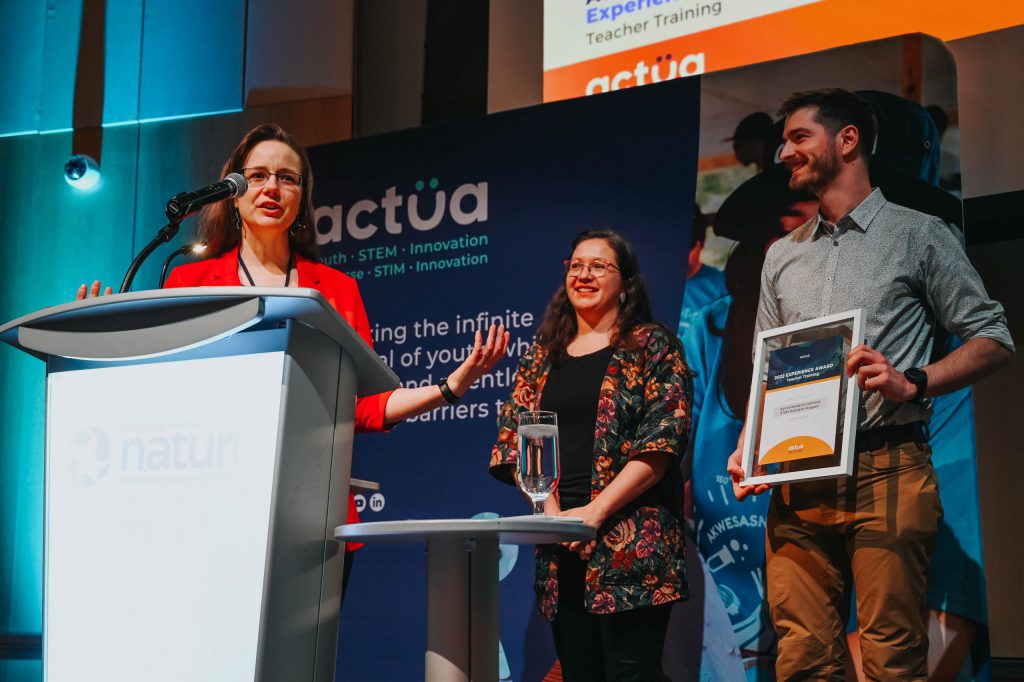
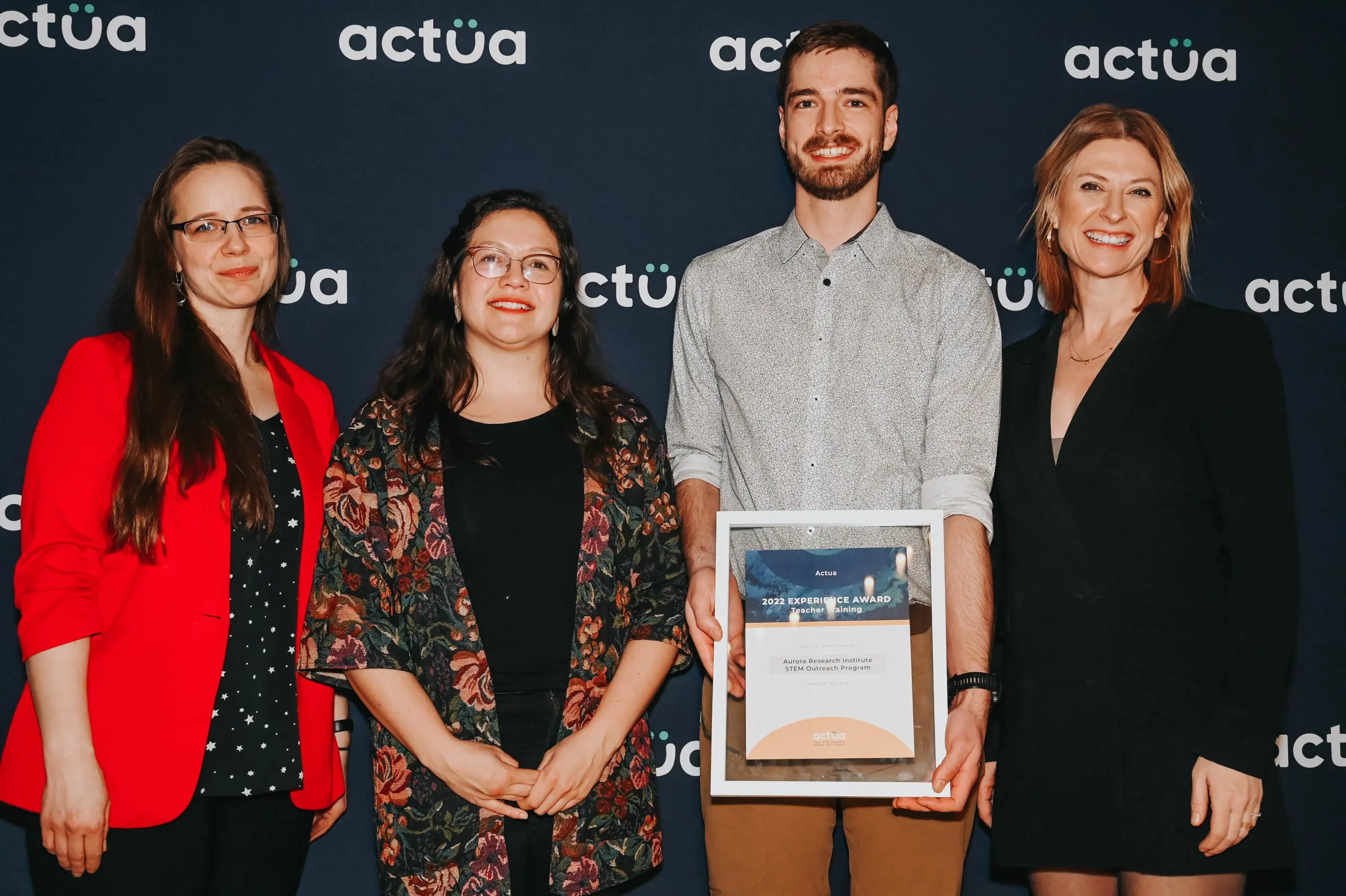
Inuvik (February 24, 2023) – The Aurora Research Institute STEM Outreach team, are co-recipients of the 2022 Actua Experience – Teacher Training Award. The team was presented with the award during the recent Actua Awards Night in Ottawa.

Actua is Canada’s largest STEM (Science, Technology, Engineering and Mathematics) outreach organization, representing a national network of 43 universities and colleges that engage youth aged six to 26 in STEM learning experiences.

The Actua Experience Award is presented annually in recognition of excellence in one of the organization’s national program areas. This year, Excellence in Teacher Training was recognized. The Aurora Research Institute (ARI) STEM Outreach team developed a “Train the Teacher, Loan the Gear” program during the COVID-19 pandemic and has continued to expand since. The program trains teachers to deliver experiential STEM programming in communities the ARI team can’t regularly reach or travel to and loans classroom kits to those teachers free of charge.

In addition to working closely with regional school divisions to deliver one-to-one training to teachers, the outreach team works with Aurora College’s Early Learning and Child Care (ELCC) Diploma program to train ELCC students to deliver age-appropriate STEM activities. The team worked with 125 NWT educators at the Northwest Territories Teachers Association (NWTTA) conference in October 2022.

The ARI STEM Outreach team has show creativity, innovation and a deep understanding of the unique local needs to develop STEM activities that captivate and educate Northern students. What began as a response to the challenges of the pandemic has grown into an exciting, thriving program that provides important supports for teachers and students across the NWT.

Team members include Annika Trimble, ARI Outreach Coordinator, Inuvik; Hilary Turko, South Slave Outreach Coordinator; Chris Black, North Slave Outreach Coordinator; and Kelly Kamo McHugh, STEM Outreach Technician, Inuvik.

Aurora College one of Canada’s top 50 Research Colleges for seventh year

La version française suit le texte anglais.

INUVIK, NT – Aurora College was recognized by Research Infosource Inc. as one of Canada’s Top 50 Research Colleges for 2022. Aurora College was ranked #42 overall among the nation’s top research colleges. This is the seventh consecutive year that Aurora College has ranked within the country’s top 50 research colleges.

Among small colleges – defined as having an annual income of less than $75 million – Aurora College is ranked #3 in both SSHRC Research Income and SSHRC Research Income as a Percentage of Total Research Income, is #10 for NSERC Research Income and #7 for NSERC Research Income as a Percentage of Total Research Income. SSHRC (Social Sciences and Humanities Research Council) and NSERC (Natural Sciences and Engineering Research Council) are two of the three major federal research funding bodies in Canada for post-secondary institutions. 

Aurora College also ranked #9 out of small colleges for Canadian Foundation for Innovation (CFI) Research Income and CFI Research Income as a Percentage of Total Research Income. For research dollars per researcher – research intensity – Aurora College was ranked #28  out of all colleges in Canada. 

The Top 50 Research Colleges rankings are determined by evaluating research income, number of research staff, number of students participating in research projects, number of research partnerships, and number of completed and on-going research projects. 

Research projects in which Aurora College leads or is involved in include the areas of physical sciences, social sciences, health, contaminants, biology, Traditional Knowledge and engineering. Current research projects include: permafrost monitoring; the effects of climate change on the northern landscape, environment, flora, fauna and ways of life; air quality monitoring; renewable energy; Northern and Indigenous health care; soil safety; geographic information systems (GIS) mapping and monitoring; traditional uses of plant species; and various youth outreach projects in science, technology, engineering and mathematics (STEM).

For more information and a complete list of Canada’s top 50 research colleges 2022, visit: https://researchinfosource.com/top-50-research-colleges/2022 

Quotes:

“Each year Aurora College continues to grow areas of research and encourages researchers from other parts of Canada and from international sites to participate in the North. The NWT has an incredibly vibrant and diverse research community with deep ties to Northern land, tradition, community and people. Aurora College will continue encouraging and supporting Northern research of high quality and relevance, as well as providing applied learning experiences to students as it transforms into a polytechnic university. It is essential that research completed in the North is for the benefit of its Northern people.”

–             Dr Glenda Vardy Dell, President, Aurora College

— 30 —

Aurora College delivers academic upgrading, trades and industrial training, certificate, diploma and degree programs to more than 3,000 full and part-time students at three campuses, 21 Community Learning Centres and other community sites in the Northwest Territories. Community-centred post-secondary programs reflect Northern culture and the needs of the Northern labour market. Aurora College’s research division, Aurora Research Institute, conducts, supports, and licenses research in the NWT. Research centres are located in Inuvik, Yellowknife and Fort Smith.

For more information, please contact:

Jayne Murray                                                                           

Manager, Communications & College Relations 

Aurora College                                                             

Phone: 867-872-7021                                                   

Email: jmurray@auroracollege.nt.ca       


POUR DIFFUSION IMMÉDIATE

26 janvier 2023

Le Collège Aurora figure dans la liste des 50 meilleurs collèges de recherche au Canada pour la septième année consécutive

Inuvik, TNO – Research Infosource Inc. a reconnu le Collège Aurora comme l’un des 50 meilleurs collèges de recherche au Canada en 2022. Le Collège Aurora se hisse à la 42e place des meilleurs collèges de recherche du pays. C’est la septième année consécutive que le Collège Aurora se classe parmi les 50 meilleurs collèges de recherche du Canada.

Parmi les petits collèges (définis comme ayant un revenu annuel inférieur à 75 millions de dollars), le Collège Aurora se classe au troisième rang pour les revenus de recherche du Conseil de recherches en sciences humaines du Canada (CRSH) et les revenus de recherche du CRSH en tant que pourcentage des revenus totaux de recherche, au dixième rang pour les revenus de recherche du Conseil de recherches en sciences naturelles et en génie (CRSNG) et au septième rang pour les revenus de recherche du CRSNG en tant que pourcentage des revenus totaux de recherche. Le CRSH et le CRSNG sont deux des trois principaux organismes fédéraux de financement de la recherche au Canada pour les établissements postsecondaires.

Le Collège Aurora s’est également classé au neuvième rang parmi les petits collèges pour les revenus de recherche de la Fondation canadienne pour l’innovation (FCI) et pour les revenus de recherche de la FCI en pourcentage des revenus totaux de recherche. En ce qui concerne les sommes consacrées à la recherche par chercheur (l’intensité de la recherche), le Collège Aurora se classe au 28e rang parmi tous les collèges du Canada.

Le classement des 50 meilleurs collèges de recherche est déterminé par l’évaluation des revenus de recherche, du nombre de membres du personnel de recherche, du nombre d’étudiants participant aux projets de recherche, du nombre de partenariats de recherche, et du nombre de projets de recherche conclus et en cours.

Le Collège Aurora mène des projets de recherche dans les domaines des sciences physiques, des sciences sociales, de la santé, des polluants, de la biologie, du savoir traditionnel et de l’ingénierie, en plus d’y participer. Les projets actuels comprennent la surveillance du pergélisol; les effets du changement climatique sur le paysage, l’environnement, la flore, la faune et les modes de vie nordiques; la surveillance de la qualité de l’air; l’énergie renouvelable; les soins de santé axés sur le Nord et destinés aux Autochtones; la sécurité des sols; la surveillance et la cartographie des systèmes d’information géographique (SIG); les utilisations traditionnelles des espèces végétales indigènes; et divers projets d’enseignement en sciences, en technologie, en ingénierie et en mathématiques (STIM) auprès des jeunes Ténois.

Pour en savoir plus et consulter la liste complète des 50 meilleurs collèges de recherche au Canada en 2022, rendez-vous au  https://researchinfosource.com/top-50-research-colleges/2022.

Citation

« Chaque année, le Collège Aurora continue de développer des domaines de recherche et encourage les chercheurs d’autres régions du Canada et de sites internationaux à participer aux activités du Nord. Les TNO ont une communauté de chercheurs dynamique, diversifiée et profondément liée à ses résidents, ainsi qu’au territoire, aux traditions, et aux collectivités nordiques. Le Collège Aurora continuera d’encourager une recherche ténoise pertinente et de qualité et de lui apporter son soutien, et de fournir aux étudiants l’occasion d’appliquer directement leurs apprentissages tout au long de la transformation du Collège en une université polytechnique. Il est essentiel que les recherches effectuées dans le Nord profitent à ses résidents. »

– Glenda Vardy Dell (Ph. D.), présidente du Collège Aurora