Search

New tricameral governance model implemented

As Aurora College prepares to transition into a polytechnic university, one of the priorities has been to establish a new tricameral governance model consisting of three bodies: the Board of Governors (the Board), the Indigenous Knowledge Holders Council (IKHC), and the Academic Council. Together, they will guide policies and operational decisions to steer the overall success of Aurora College.

The unique make-up of the tricameral system will ensure that governance reflects the diverse needs and perspectives of Northern communities. It will also promote greater autonomy and responsiveness to territorial and regional demands, positioning the Northwest Territories as a global leader in northern and Arctic education and research.
The overarching responsibility of the Board of Governors is to establish and advance the long-term vision of Aurora College. It is also responsible for monitoring and driving successful implementation of the College’s vision, mission and values. The Board of Governors is responsible for oversight of College facilities, finances and risk management. It also serves in an intermediary role between the College and the Minister for Education, Culture and Employment.

The Board of Governors has an essential role in developing an arm’s length relationship between the Government of the Northwest Territories and Aurora College. The Board will ensure diversity in appointments, with competencies being the priority for appointments. A minimum of five of the ten “at large” members must be Indigenous residents of the NWT. One student and two staff representatives sit on the Board, as well as the College President.

The Indigenous Knowledge Holders Council’s role is to promote policies and operational decisions that foster the success of Indigenous students and staff at Aurora College and the overall success of the institution. The IKHC will develop and monitor implementation of a framework that guides Aurora College in all areas of strategic and operational decision-making and that respects and honours the worldviews, traditions, cultures and histories of the Indigenous Peoples of the Northwest Territories. The IKHC has recently shared their Flowing Waters Framework, which sets up guiding principles and priorities for 2024-2027.

The Academic Council is the senior academic body of Aurora and is comprised of staff, faculty and student representatives. It advises the Board of Governors, makes recommendations on all academic matters, and helps to build the College’s capacity to make academic decisions. The creation of the Academic Council will help Aurora College to meet quality assurance requirements connected to academic decisions and ensure academic freedom. The Council is an interim step towards establishing a Senate as Aurora College transforms into a polytechnic university.

The unique make-up of the tricameral system will ensure that governance reflects the diverse needs and perspectives of Northern communities. It will also promote greater autonomy and responsiveness to territorial and regional demands, positioning the Northwest Territories as a global leader in northern and Arctic education and research.
Observer Communicators: keeping northern flights safe

If you’ve ever wondered who helps keep the planes flying in and out of northern communities safe, the answer is closer than you might think.

Observer Communicators – specialists who convey critical weather information, runway conditions and other essential information to pilots – help ensure that flights land and depart safely at small airports across Canada’s far North.
Based at Thebacha Campus in Fort Smith, the Observer Communicator program prepares graduates to serve a vital role at Community Aerodrome Radio Stations (CARS) in the Northwest Territories, Yukon, Nunavut and Northern Quebec. Aurora College is the only institution in Canada that offers this specialized training.

The NAV CANADA training is an intensive 10-week program that blends classroom instruction with hands-on training in radio communications and aviation weather observing. In simulated radio rooms, students practice their skills in real-world scenarios that can range from managing aircraft and ground vehicles to coordinating emergency responses.

Participants in program are normally chosen by ATS Services, the main employer of Observer Communicators, rather than applying directly to Aurora College. Most graduates go directly into jobs with ATS Services or territorial aviation agencies in small Northern communities. Senior instructor George Skippings notes that ideal candidates are residents of these communities, and that the program is designed to build northern capacity.

Aurora College runs four intakes per year—in January, April, July, and October. Students hail from across the territories and beyond, ranging from young adults to people seeking a new career. While the program requires a minimum of Grade 10 education, the most successful participants are curious about aviation, detail-oriented, and possess strong communication and literacy skills.

To learn more, check out Observer/Communicator – Aurora College or ATS Services.

High school students “TAP” into skilled trades

For several years, the Canada-wide shortage of skilled tradespeople has been growing, and is sharply felt in the NWT – especially in the smaller communities. According to Employment and Social Development Canada, nearly one in five of the four million Canadians who currently work in trades is poised to retire by 2030, while the number of young people entering the trades continues to decline. Exposing young people to the trades and helping them consider trades as a viable career option are crucial to helping reverse this trend.
Since 2005, Aurora College has delivered the week-long Trades Awareness Program (TAP) sessions to high school students in the South Slave. In recent years, TAP has expanded to include students from schools in the Tlicho, Dehcho, Sahtu and Beaufort Delta regions, as well as a summer camp option. The aim of TAP is to give students from small high schools access to a variety of trades that they can try out and explore in a safe, fun, educational environment, and perhaps consider a career in trades.
Students first participate in the one-week Introductory TAP, in which they spend one day in each of four trades, attend workshops about career and post-secondary planning and opportunities, experience “College life”, meet students from other communities and participate in recreational activities. They can then return for up to two week-long Intensive TAP sessions, where they focus on one trade for four days. Trades offered have included Carpentry, Electrical, Cooking, Mechanical, Plumbing, Welding, and Hairdressing, among others.
Each delivery is a partnership between Aurora College, regional school divisions, the department of Education, Culture and Employment, local business, and can include Indigenous governments, corporate sponsors and other GNWT departments. Since 2005, nearly 2,000 students have participated in the Trades Awareness Program, and several have gone on to become Journeypersons or work in a skilled trade.
School divisions interested in more information can email TAIT.Training@auroracollege.ca.

Driving success: Big rigs, haul trucks and heavy equipment

At the Centre for Mine and Industry Training, students in Heavy Equipment Operator, Class 1 and Class 3 Driver training, and mining programs practice operating big rigs, haul trucks and various pieces of heavy equipment on state-of-the-art simulators. The simulators integrate cutting-edge technology with operational situations, providing a real-world sensory experience, including replicating vibrations and machine behaviour, such as weight shifting. Students practice on a variety of scenarios that mimic real-world job sites, and then receive a detailed evaluation of their session to ensure continuous improvement.
Heavy Equipment Operator training was the first course offered in Fort Smith in 1968, and remains one of the most popular. The full 15-week program at Thebacha Campus provides up to 185 hours of hands-on training on two pieces of equipment, as well as classroom work that covers preventative maintenance procedures, first aid and safety certifications and general knowledge. Shorter courses are often offered off-site in partnership with communities and Indigenous governments.
Aurora College was the first training provider in the NWT to offer the new, mandatory Class 1 Driver Entry Level Training (ELT) The five-week program runs up to eight times throughout the year. The training prepares students to take the written and practical Class 1 Drivers testing. Class 3 Driver Training is also offered at Thebacha Campus. Through a new reciprocal agreement with Alberta, residents of that province with Alberta Class 5 licences who successfully complete the Aurora College Class 1 ELT training can test for their Alberta Class 1 licence.
In partnership with Indigenous governments, communities and industry, Aurora College offers several mine training programs. The five-week Introduction to the Mining Industry can be delivered off-site or at Thebacha Campus, and is the prerequisite for both Underground Miner and Surface Miner programs.
More information about Industrial Training programs can be found on our website or email TAIT.Training@auroracollege.ca.

Seven new programs to support NWT trades

Skilled tradespeople are essential for the vibrancy of NWT communities. To help meet the growing need for northern-based tradespeople, Aurora College is adding seven new trades and apprenticeship programs to an already robust roster.

Three new Fundamentals programs – Pipe Trades, Mechanics and Welding – will deliver a combination of hands-on and academic coursework to prepare individuals for Level 1 apprenticeship exams and provide students with valuable skills to help them enter the trades. The College recently introduced Fundamentals of Carpentry and Fundamentals of Electrical as well.

Apprenticeship options will be expanded, with the addition of Automotive Service Technician Levels 1 & 2, Plumbing Level 3, and Heavy Equipment Technician Level 3 (Off Road). Current Carpentry, Plumbing and Electrician apprenticeship programs will be upgraded with new tools and technology.

Funding for the new programs and equipment is through a $625,018 grant from the Canadian Apprenticeship Strategy’s Union Training and Innovation Program (UTIP) – Investments in Training Equipment Stream. UTIP is part of the Canadian Apprenticeship Strategy’s response to the skilled trades workforce’s most pressing needs, including addressing barriers to successfully entering skilled trades, addressing the housing crisis, and increasing net-zero construction to help fuel economic growth. This investment by the Government of Canada will help Aurora College ensure trainees have access to the most up-to-date technology so they can meet and exceed industry standards and is part of Aurora College’s commitment to enhancing and expanding trades training opportunities in the North.

Quality, skills-based training to meet Northern needs

Before experiencing it for themselves, many people don’t realize the gem that is Aurora College’s School of Trades, Apprenticeship and Industrial Training (TAIT). The facilities, training equipment, range of programming, curriculum and quality of instructors rival what is available at larger institutions while offering lower student-instructor ratios and more one-on-one attention from instructors.

Based at Thebacha Campus in Fort Smith, TAIT delivers unique, northern-focused, high-quality skills-based training that is developed and delivered with the northern learner and northern labour market in mind.
Spacious, modern, well-equipped shop facilities and classrooms for apprenticeship and trades programs fill the entire west wing of the main campus. A short walk away is the Centre for Mine and Industry Training which was built specifically to deliver mining, heavy equipment and Class 1/Class 3 driver training. Hands-on training with heavy equipment, large haul trucks and other mining equipment takes place at private practice sites near Fort Smith.

Each program has a rigorous curriculum designed to prepare students for success, with ongoing efforts to meet the North’s growing demand for skilled workers and to provide students with best possible training and career opportunities. The curriculum for apprenticeship technical training at Aurora College is recognized by Alberta, Yukon and Nunavut, in addition to the NWT.
Program offerings are chosen to respond to needs of communities, employers, and students. In addition to traditional apprenticeship and trades deliveries, the College has developed, adopted or adapted a number of unique options, including Observer Communicator, Non-apprenticeship Housing Maintainer and a stand-alone Oil Heat Systems Technician program.

As a northern institution, Aurora College is proud of the fact that the majority of TAIT instructors are long-time northerners – many of whom are Indigenous, and many received trades education at the College. As well, most TAIT instructors have extensive work experience within the NWT and in the north, so are able to share that experience and understanding with their students.

Partnerships with Northern businesses, industry, and industry organizations are key to helping ensure curriculum and training are aligned with the needs of Northern labour market. Aurora College is grateful for the support of these partners, including De Beers Group, Diavik Diamond Mine, and Ekati.

STEM Outreach program brings hands-on, fun learning to NWT students

October is Cyber Safety Awareness month, promoting ways Canadians can stay safe online. Aurora College’s STEM Outreach Program is offering a series of interactive classroom activities to help students in Grades 1–7 learn about online safety, encryption, and digital citizenship in fun and age-appropriate ways.

The STEM Outreach Program is dedicated to inspiring and empowering youth across the Northwest Territories through engaging, hands-on science, technology, engineering, and mathematics (STEM) education. Over the past eight years, the Outreach team has provided high-quality STEM programming to approximately 8,000 JK–Grade 12 students each year, with a strong focus on reaching remote and underserved NWT communities.

Led by a team of three full-time staff and additional part-time educators based in Inuvik, Yellowknife, and Fort Smith, the program strives to remove some of the financial and regional barriers to STEM education by providing all STEM programming for free. Through in-class visits, after-school programs, and remote activities, the STEM Outreach program ensures that all youth across the NWT have access to meaningful STEM experiences.

Innovative initiatives such as the award-winning “Train the Teacher, Loan the Gear” program equip educators with the tools and confidence to integrate STEM into their classrooms. The Outreach Team also hosts events such as Community Science Nights, Science Rendezvous, and Geoweek, as well as providing resources for summer camps, libraries, and youth centres.

Educators and community groups: Reach out to the STEM Outreach team at: outreach@nwtresearch.com .

Junior Achievement workshops added to recent Trades Awareness Programs

In September, Aurora College’s Trades Awareness Program (TAP) partnered with Junior Achievement Canada (JA) and Colleges and Institutes Canada (CICan) to offer an expanded Youth Symposium to high school students from the South Slave, Dehcho and Tłı̨chǫ regions.

The two week-long Introductory Trades Awareness Programs were hosted at Thebacha Campus in Fort Smith. Along with the opportunity to try out four different trades, students participated in Junior Achievement’s “Be Entrepreneurial” program, budgeting and personal finance sessions, workshops to help plan for post-secondary education, and a variety of evening recreational activities. Nearly 100 students took part over the two weeks. Students could choose between carpentry, cooking, electrical, hair dressing, pipe trades and welding. After completing the Introductory TAP, students are eligible to attend the week-long Intensive program, in which they spend four days exploring a trade.

Since 2005, Aurora College has partnered with the South Slave Divisional Education Council and Education (ECE), Culture and Employment to offer TAP to South Slave students. During the past several years, partnerships with other regional school divisions and funders has allowed students from Dehcho, Tłı̨chǫ, Beaufort Delta and Sahtu regions to participate as well.

TAP was set up to introduce high school students from smaller communities to the trades as a potential career choice. Since 2005, more than 2,000 NWT students have participated, some of whom have gone on to become apprentices and journeypersons.

Aurora College will be hosting additional Trades Awareness sessions in the 2025-2026 academic year. Interested schools or school divisions can contact TAIT.Training@auroracollege.ca for more information.

Truth and Reconciliation at Aurora College

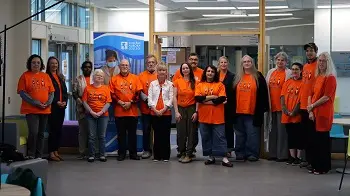
In recognition of the National Day for Truth and Reconciliation on September 30, Aurora College held a number of events for students, staff and community members in Fort Smith, Yellowknife and Inuvik. The events were held to honour the strength and resiliency of Indigenous communities while acknowledging the painful truths of our nation and our shared path forward.

Thebacha Campus’s Truth and Reconciliation Week ran from Sept. 23 to 29 and was led by the Culture Committee, which plays an active role in honouring Indigenous culture year-round. Events included a Feeding of the Fire ceremony, daily virtual sessions from the National Centre for Truth and Reconciliation, bannock and bead-making workshops, a drymeat-making demonstration, Indigenous games demonstrations, and a pow wow dancing demonstration. Most of the events were led by local Elders.

In Inuvik, Inuvialuit Regional Corporation (IRC) health support worker and residential school survivor, Jeffrey Amos, shared his personal experiences with Aurora Campus students, faculty and staff. He spoke to the lasting impacts of the residential school system and the ongoing process of healing and resilience, underscoring the importance of sharing stories and acknowledging the history that continues to shape Northern Indigenous communities. Students and staff then shared a traditional lunch with roasted caribou, soup and whitefish.

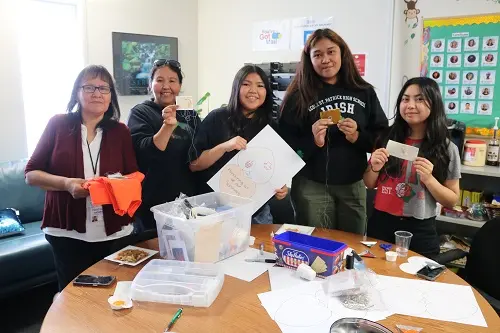
Yellowknife North Slave Campus marked the week with a variety of events. The Early Learning and Child Care program hosted a “Soup and Sew”, while at the main campus, students and staff participated in a “Mindful Monday” lunch and a “Heart Garden” activity, crafting healtfelt messages of support and hope to share.

As a post-secondary institution in the Northwest Territories, Aurora College commits to ensuring the Indigenous ways of knowing, being, doing, and believing remain grounding principles of our educational influence, and honour the opportunity to live and learn on the Homeland of the Dene, Métis, Inuvialuit, and NWT Cree.

Our culture will remain true to the tenet that education is the key to true Reconciliation, and traditional knowledge shared by Indigenous communities helps lay the path forward toward a more equitable future for all.

Check out all of the photos of our Truth and Reconciliation Day activities!

Celebrating Personal Support Workers Day – June 24

Personal Support Workers Day in the NWT was celebrated this year on June 24. Observed on the last Tuesday of June, the day recognizes the essential role Personal Support Workers (PSWs) play in promoting health, dignity, and well-being of individuals across the territory. PSWs provide compassionate care in Elders homes, in hospitals, in homes, one-on-one in schools, and more.

Aurora College is proud of our Personal Support Worker Certificate program, students, alumni, faculty and staff for the tremendous contribution they make health care in the Northwest Territories. Two of our graduates were honoured recently for their exceptional dedication and hard work.

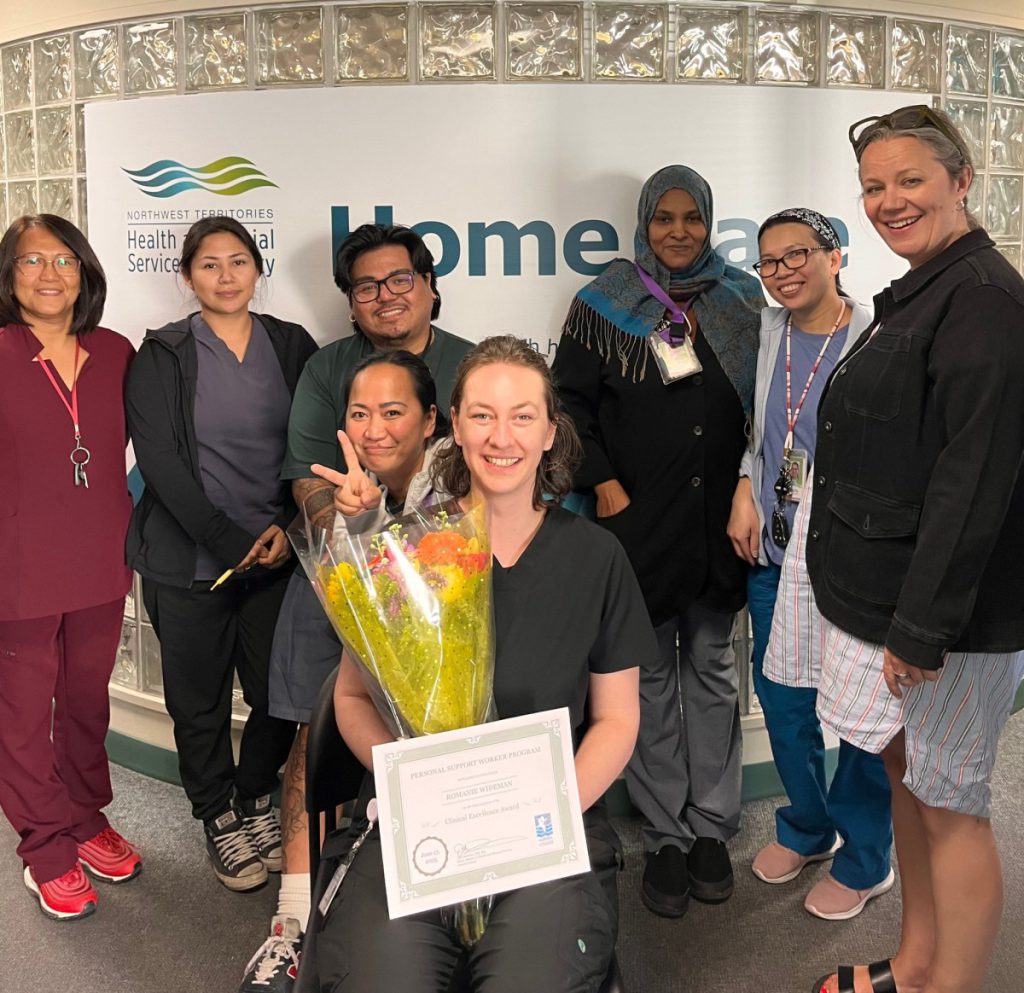
Romanie Wideman, pictured in the centre, was presented with the Clinical Excellence Award at Home Care – NTHSSA Yellowknife Region, where she is completing her final practicum course with a wonderful team of support workers.

Clinical Excellence Award
2025 graduate Romanie Wideman received the Clinical Excellence Award. The faculty-nominated honour recognizes a student who demonstrates outstanding skill and professionalism in the clinical setting. She was presented with the award during her final practicum at Home Care – NTHSSA Yellowknife Region, where she worked alongside a team that includes many Aurora College alumni.

AVENS Sheila Broders Award
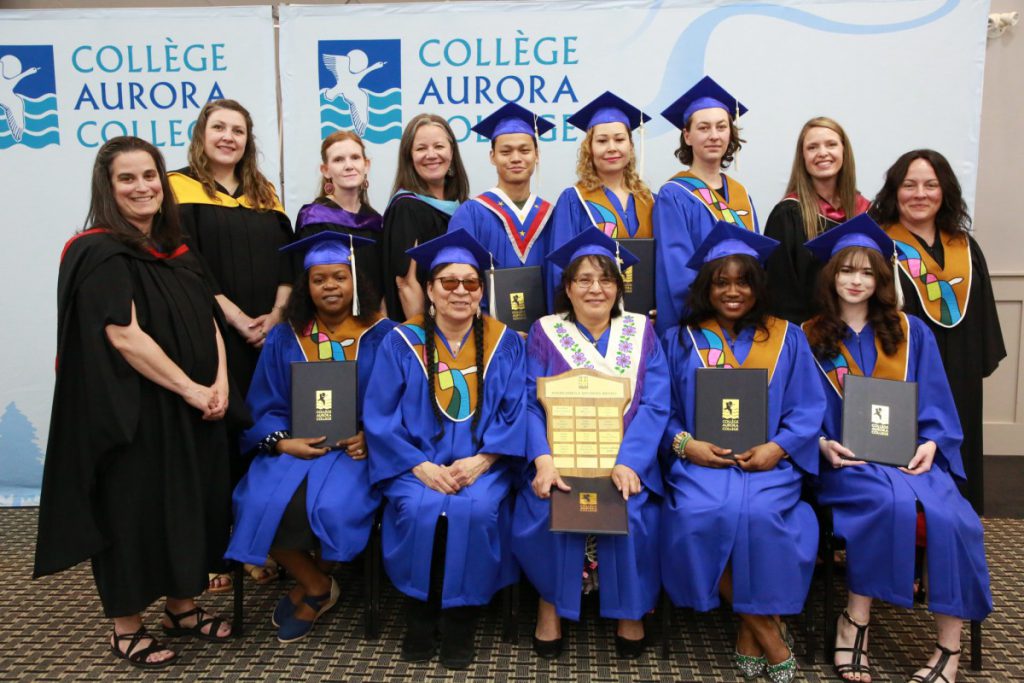
Graduate Diane Lafferty of Behchokǫ̀ was recognized with the AVENS Sheila Broders Award. Presented during the Yellowknife Convocation Ceremony by AVENS Care Manager Sandra Crocker-Walsh, the award celebrates Diane’s dedication and excellence in caregiving to AVENS residents during her practicum.

Chair of Health and Human Services, Jodi Brennan, emphasized the importance of recognizing the contributions of PSWs. “It’s important to honour students who strive for clinical excellence and to celebrate the commitment Personal Support Workers bring to our communities every day.”

Graduate Diane Lafferty (pictured first row, third from right) of Behchokǫ̀ was recognized with the AVENS Sheila Broders Award during the Yellowknife Convocation Ceremony last month.

Aurora College’s PSW program offers flexible delivery options—including in-person and distance learning —making it accessible to Northerners throughout the territory. In 10105-2026, students care study in-person, full-time at Yellowknife North Slave Campus; in-person, part-time in Behchokǫ̀, Fort Smith and Inuvik; or through distance delivery anywhere in the territory.

Online application deadline for the program is June 30, 2025; students can apply to individual courses as they are offered.