| La version française suit le texte anglais. Yellowknife (February 23, 2023) – In keeping with the commitment the Government of the Northwest Territories (GNWT) has made to ensure Northwest Territories (NWT) residents are kept informed during the transformation of Aurora College to a polytechnic university, NWT residents are advised that updates have been made to the critical milestone timeline for Aurora College Transformation. One exciting addition to the critical milestone timeline is the Bachelor of Education, Bachelor of Social Work and General Arts & Science Programs. Aurora College is working to have year 1 of these programs implemented by September 2024. These renewed degree programs will allow students to stay connected with their culture and lands, as well as fill a critical gap in the labour force. Made in the North programming will empower our students to play a leading role in supporting their communities. As we come to the end of the 19th Legislative Assembly and halfway through transformation, it makes operational sense to do an assessment of the critical milestones timeline and adjust commitments as necessary. The updated timeline identifies with different colours which critical milestones have not changed and are complete, which have been delayed slightly, and which ones have been added. Most of the adjustments to milestone dates occurs in phase 2, which is the phase that contains the bulk of the work. Delays in milestone dates are a result of a combination of an increase in activities required to complete each milestone and capacity at Aurora College. Along with the addition of the Aurora College programs, the establishment of the Indigenous Knowledge Holders Council and implementation of the polytechnic university funding formula have also been added as new milestones. These projects have been added as critical milestones because they are critical elements in the successful transformation of Aurora College to a polytechnic university. Though there have been adjustments to critical milestone dates, all critical milestone commitments are still on track to be fulfilled by October 2026. To keep up to date with transformation visit: Aurora College Transformation (gov.nt.ca). Quotes: “At the start of transformation, the GNWT committed to supporting the re-introduction of the education and social work programs, which are important to the successful transformation of Aurora College to a polytechnic university. I am pleased that Aurora College and the Dept. of ECE have taken operational steps to update the critical milestone timeline, that includes a new milestone to reintroduce these important programs. I look forward to welcoming a new cohort of students in the fall 2024 intake.” -R.J. Simpson, Minister of Education, Culture and Employment “The introduction of university level general studies and the return of social work and education programs are an important step in Aurora College’s plans to increase access to post-secondary educational opportunities for NWT residents. The programs will open doors to educational and career opportunities for graduates who will, in turn, provide care, mentorship and support to generations of Northerners. Aurora College will continue to prioritize engagement with Indigenous and community governments, education partners and employers in the development of new programs.” –Glenda Vardy Dell, President, Aurora College Quick facts: · Transformation is often presented as one project, but it is in fact a collection of over 100 projects, spread over three phases. · The GNWT is working collaboratively with Aurora College to support the development and implementation of these renewed programs. · The polytechnic university is scheduled to be launched in May 2025, with the completion of all critical milestones by October 2026. Related Links: · Critical Milestone Timeline · Aurora College Transformation Website December 2022 Aurora College Transformation Quarterly Report (contains information about Aurora College program review) Yellowknife, le 23 février 2023 – Conformément à son engagement visant à tenir les Ténois informés tout au long du processus, le gouvernement des Territoires du Nord-Ouest (GTNO) signale que des mises à jour ont été apportées à l’échéancier des étapes critiques, dans le cadre de la transformation du Collège Aurora en université polytechnique. Un ajout des plus intéressants à l’échéancier des étapes critiques : un baccalauréat en éducation, un baccalauréat en service social et des programmes généraux d’arts et de sciences. Le Collège Aurora s’emploie à ce que la première année de ces programmes d’études soit accessible dès septembre 2024. Ces nouveaux programmes de diplômes universitaires permettront aux étudiants de maintenir un lien avec leur culture et leur territoire, tout en aidant à pallier une pénurie importante en matière de main-d’œuvre. Ces programmes propres au Nord donneront à nos étudiants la possibilité d’être en première ligne pour aider leurs collectivités. Alors que le mandat de la 19e Assemblée législative touche à sa fin et que nous en sommes à mi-chemin du processus de transformation, il paraît judicieux, sur le plan opérationnel, d’examiner l’échéancier des étapes critiques et de revoir les engagements, si besoin est. L’échéancier mis à jour indique, à l’aide de couleurs différentes, les étapes critiques qui n’ont pas changé, celles qui ont été atteintes, celles qui connaissent un léger retard et celles qui ont été ajoutées. La plupart des ajustements apportés aux dates limites concernent la phase 2, qui regroupe la majorité du travail à accomplir. Les dates limites ont été reportées en raison d’une augmentation du nombre d’activités requises pour mener à bien chaque étape, ainsi qu’en raison de la capacité au Collège Aurora. Outre l’ajout de programmes offerts au Collège Aurora, deux nouvelles étapes critiques ont été ajoutées, à savoir la création du Conseil des détenteurs du savoir traditionnel et la mise en œuvre de la formule de financement de l’Université polytechnique. Ces projets ont été ajoutés à l’échéancier, car ils constituent des éléments essentiels à la réussite de la transformation du Collège Aurora en université polytechnique. Malgré les ajustements apportés aux dates limites de certaines étapes critiques, tous les engagements pris devraient être respectés d’ici octobre 2026, comme prévu. Pour vous tenir au courant de l’avancement de la transformation, rendez-vous sur la page Transformation du Collège Aurora (gov.nt.ca). Citations « Au début de la transformation, le GTNO s’est engagé à soutenir la réintroduction de programmes d’études axés sur l’éducation et le service social, qui sont des éléments essentiels à la bonne transformation du Collège Aurora en université polytechnique. Je suis ravi que le Collège Aurora et le ministère de l’Éducation, de la Culture et de la Formation aient pris des mesures, sur le plan opérationnel, afin de mettre à jour l’échéancier des étapes critiques, qui comprend une nouvelle étape visant la réintroduction de ces programmes importants. J’ai hâte de pouvoir accueillir un nouveau groupe d’étudiants à l’automne 2024. » – R. J. Simpson, ministre de l’Éducation, de la Culture et de la Formation « L’introduction d’études générales de niveau universitaire et le retour des programmes de service social et d’éducation forment une étape importante des plans du Collège Aurora visant à accroître l’accès aux possibilités d’études postsecondaires pour les Ténois. Ces programmes ouvriront des portes vers des possibilités d’études et de carrières pour les diplômés, qui, à leur tour, offriront des soins, du mentorat et du soutien à des générations de Ténois. Le Collège Aurora continuera de prioriser les échanges avec les gouvernements autochtones et les administrations communautaires, les partenaires du domaine de l’éducation et les employeurs dans le cadre de l’élaboration de nouveaux programmes. » – Glenda Vardy Dell, présidente du Collège Aurora Faits en bref · Quoique souvent désignée comme étant un seul projet, la transformation du Collège Aurora se compose en réalité de plus d’une centaine de projets, répartis en trois phases. · Le GTNO collabore avec le Collège Aurora pour soutenir l’élaboration et la mise en œuvre de ces programmes renouvelés. · L’université polytechnique devrait ouvrir ses portes en mai 2025 et toutes les étapes critiques devraient être achevées d’ici octobre 2026. Liens connexes · Échéancier des étapes critiques · Site Web sur la transformation du Collège Aurora · Rapport trimestriel sur la transformation du Collège Aurora – Décembre 2022 (contient des informations sur l’examen des programmes du Collège Aurora) |
Month: February 2023
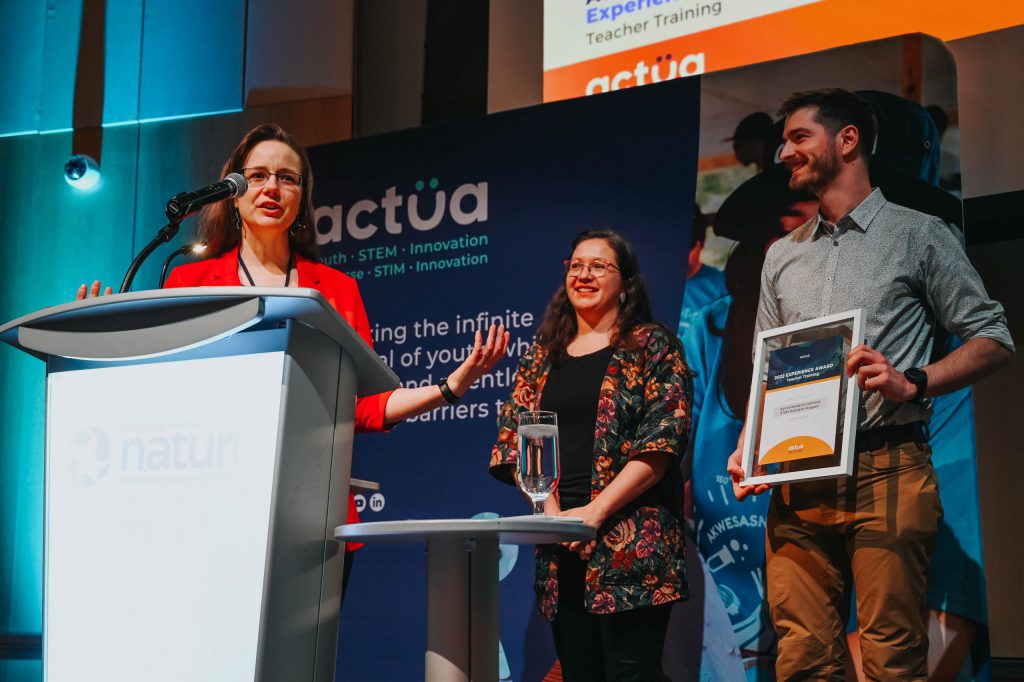
Aurora Research Institute STEM Outreach receives Actua Experience Award
Inuvik (February 24, 2023) – The Aurora Research Institute STEM Outreach team, are co-recipients of the 2022 Actua Experience – Teacher Training Award. The team was presented with the award during the recent Actua Awards Night in Ottawa.
Actua is Canada’s largest STEM (Science, Technology, Engineering and Mathematics) outreach organization, representing a national network of 43 universities and colleges that engage youth aged six to 26 in STEM learning experiences.
The Actua Experience Award is presented annually in recognition of excellence in one of the organization’s national program areas. This year, Excellence in Teacher Training was recognized. The Aurora Research Institute (ARI) STEM Outreach team developed a “Train the Teacher, Loan the Gear” program during the COVID-19 pandemic and has continued to expand since. The program trains teachers to deliver experiential STEM programming in communities the ARI team can’t regularly reach or travel to and loans classroom kits to those teachers free of charge.
In addition to working closely with regional school divisions to deliver one-to-one training to teachers, the outreach team works with Aurora College’s Early Learning and Child Care (ELCC) Diploma program to train ELCC students to deliver age-appropriate STEM activities. The team worked with 125 NWT educators at the Northwest Territories Teachers Association (NWTTA) conference in October 2022.
The ARI STEM Outreach team has show creativity, innovation and a deep understanding of the unique local needs to develop STEM activities that captivate and educate Northern students. What began as a response to the challenges of the pandemic has grown into an exciting, thriving program that provides important supports for teachers and students across the NWT.
Team members include Annika Trimble, ARI Outreach Coordinator, Inuvik; Hilary Turko, South Slave Outreach Coordinator; Chris Black, North Slave Outreach Coordinator; and Kelly Kamo McHugh, STEM Outreach Technician, Inuvik.
Northern Nursing Research Day celebrates Aurora College students
La version française suit le texte anglais.
YELLOWKNIFE, NT – Aurora College Bachelor of Science in Nursing (BSN) students and faculty celebrated and shared their knowledge at the annual Northern Nursing Research Day, held on November 30. The School of Health and Human Services Research Day is an opportunity to showcase and honour scholarship and academic work of students, faculty and invited scholars, and to celebrate student success
.
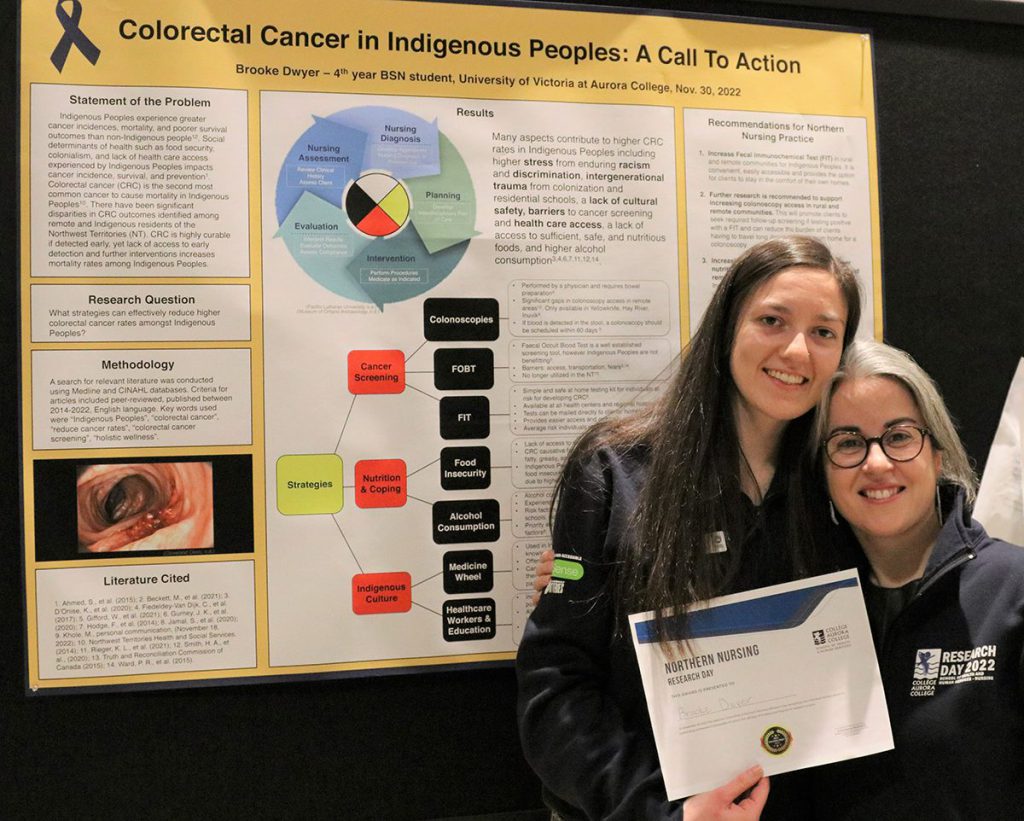
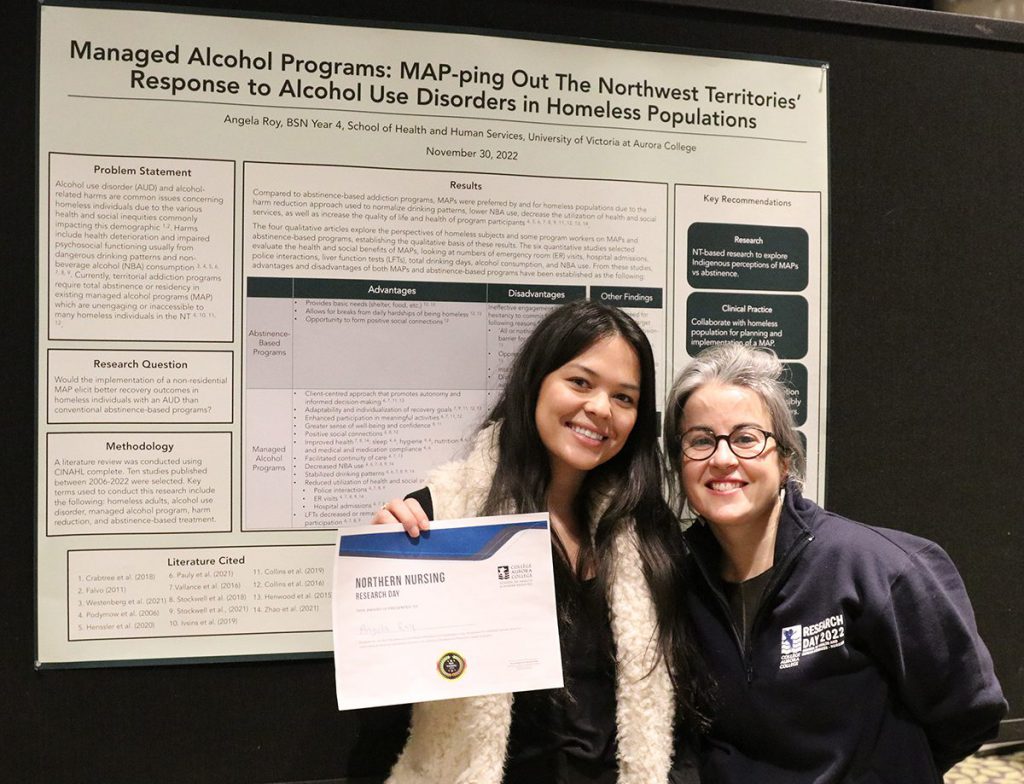
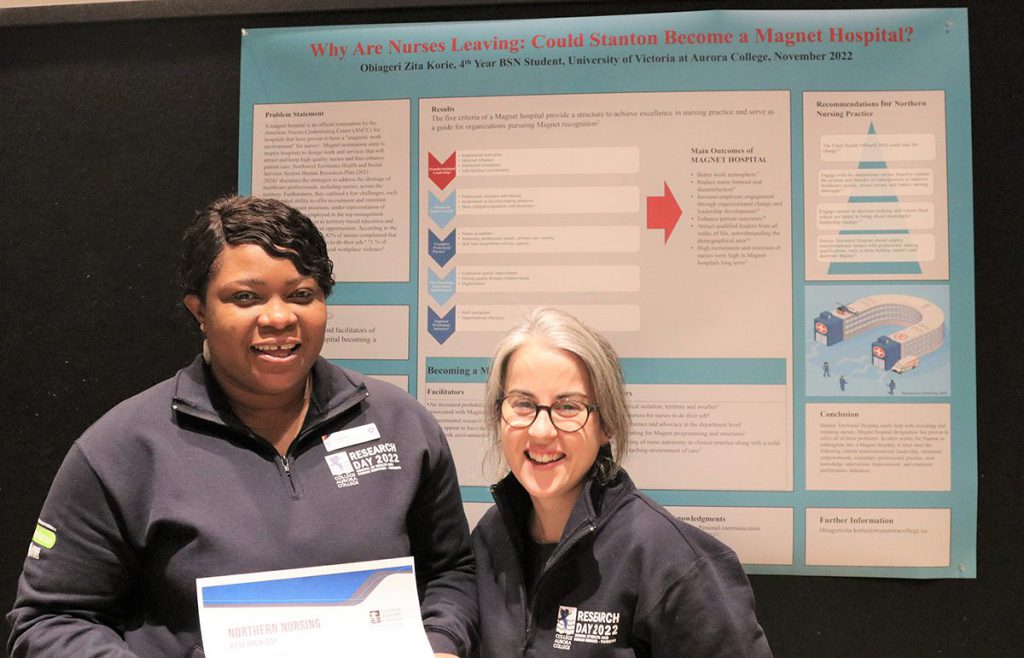
This year, the event was hosted by Aurora College and Hotıì ts’eeda. A total of 23 posters were featured – 19 literature review researches from fourth-year BSN students and four research projects led by the faculty.
Guest speakers shared information about cultural safety and safe nursing practice, as well as how to implement the United Nations Declaration on the Rights of Indigenous Peoples in health research and services in the North.
The theme of this year’s Research Day was “Clinical Safety in our Northern Context” and was divided into three broad areas: Moving Towards Health Equity; Supporting Nursing Education & Workforce; and Clinical Innovations for Nursing Practice. The topics chosen for the research posters and the unique approaches taken by the students underscore the importance of developing and applying research that is for the North, by the North and with the North, to improve the quality of care and to prioritize decolonizing approaches to advance nursing knowledge.
Three awards were presented to students at the event:
Creativity Award – Angela Roy for Managed Alcohol Programs: MAP-ping Out the NWT’s Response to Alcohol Use Disorders in Homeless Populations;
Scientific Rigour Award – Brook Dwyer for Colorectal Cancer in Indigenous Peoples: A Call to Action; and
People’s Choice Award – Obiageri Zita Korie for Why Are Nurses Leaving: Could Stanton Become a Magnet Hospital?
The research projects are the culmination of the fourth-year students’ Nursing Research course. The intent of the course is to increase understanding of nursing scholarship and enhance the students’ ability to comprehend, critique and utilize nursing research. To create the final product, students developed a research question, search and collected literature and evidence, appraised the evidence, organized their findings, and then created recommendations for the clinical, research, education, and/or policy level, applicable to a northern context.
Students were also invited by Hotıì ts’eeda to display their research posters again for the Dene Nation during their leadership meetings on December 14. Check out their research posters here.
— 30 —
Quotes:
“Colorectal cancer is the second most common cancer to cause mortality in Indigenous Peoples and is under reported in Indigenous Peoples in the North. It is important to collect this data to find ways to reduce these incidences. Northern research is imperative to reduce the current inequities and disparities amongst this population.”
– Brooke Dwyer, Bachelor of Science in Nursing student, recipient of Scientific Rigour Award
“Northern-based research is key for inclusivity and cultural safety as it relates to Indigenous communities. The variations in the territory’s population (ethnicity, culture, age, geography) require special consideration to ensure any interventions are suitable; the rurality of the NWT makes it difficult to generalize and apply findings from other studies; and Indigenous Peoples deserve recognition in the research domain if findings are to be applied to them.”
– Angela Roy, Bachelor of Science in Nursing Student, recipient of Creativity Award
“My research focused on Magnet Hospitals and their ability to attract high-quality health professionals, improve patient outcomes and retain hired nurses. Magnet hospitals create structures that involve nurses in decision-making, policies and research – ensuring that nurses have all the resources to do their jobs. The current rate of nurses leaving bedside care globally and in the NWT threatens the health care system, patient safety, quality of patient care and nurse retention.”
– Obiageri Zita Korie, Bachelor of Science in Nursing student, recipient of Peoples’ Choice Award
YELLOWKNIFE, TNO – Les étudiants au baccalauréat en sciences infirmières et les enseignants du Collège Aurora ont célébré et partagé leurs connaissances lors de la Journée annuelle de recherche nordique sur les soins infirmiers, qui a eu lieu le 30 novembre. La journée de la recherche de l’École des services de santé et des services sociaux est l’occasion de mettre en valeur et d’honorer les travaux de recherche et les travaux universitaires des étudiants, des professeurs et des chercheurs invités, et de souligner la réussite des étudiants.
Cette année, l’événement était organisé par le Collège Aurora et Hotıì ts’eeda. Au total, 23 affiches ont été présentées, dont 19 recherches par analyse documentaire effectuées par des étudiants en quatrième année du baccalauréat en sciences infirmières et quatre projets de recherche menés par le corps enseignant.
Les conférenciers invités ont partagé des informations sur la sécurité culturelle et la pratique sûre des soins infirmiers, ainsi que sur la manière de mettre en œuvre la Déclaration des Nations Unies sur les droits des peuples autochtones dans la recherche et les services de santé du Nord.
Cette année, le thème de la Journée de la recherche était « La sécurité clinique dans notre contexte nordique », thème divisé en trois grands volets : Vers l’équité en santé, Soutenir l’éducation et la main-d’œuvre infirmières et Innovations cliniques pour la pratique infirmière. Les sujets choisis pour les affiches de recherche et les approches uniques adoptées par les étudiants soulignent l’importance de développer et d’appliquer une recherche pour le Nord, par le Nord et avec le Nord, afin d’améliorer la qualité des soins et de privilégier les approches décolonisatrices pour faire progresser les connaissances dans le domaine des soins infirmiers.
Trois prix ont été remis à des étudiants lors de l’événement :
Prix de la créativité – Angela Roy pour Managed Alcohol Programs: MAP-ping Out the NWT’s Response to Alcohol Use Disorders in Homeless Populations (Programmes de gestion de l’alcool : Cartographie de la réponse des TNO aux troubles de la consommation d’alcool chez les itinérants);
Prix de la rigueur scientifique – Brook Dwyer pour Colorectal Cancer in Indigenous Peoples: A Call to Action (Le cancer colorectal chez les peuples autochtones : Un appel à l’action);
Prix Choix du public – Obiageri Zita Korie pour Why Are Nurses Leaving: Could Stanton Become a Magnet Hospital? (Pourquoi le personnel infirmier part : Stanton pourrait-il devenir un hôpital magnétique?)
Les projets de recherche sont l’aboutissement du cours de recherche en soins infirmiers des étudiants de quatrième année. L’objectif de ce cours est de mieux comprendre la recherche en soins infirmiers et d’améliorer la capacité des étudiants à comprendre, critiquer et utiliser cette recherche. Pour créer le produit final, les étudiants ont développé une question de recherche, ont examiné la documentation et les données probantes, ont évalué les données probantes, ont organisé leurs résultats et ont ensuite formulé des recommandations pour le niveau clinique, la recherche, l’éducation ou les politiques, applicables au contexte nordique.
Les étudiants ont également été invités par Hotıì ts’eeda à exposer à nouveau leurs affiches de recherche pour la Nation dénée lors de leur réunion avec les leaders le 14 décembre. Consultez les affiches de recherche ici.
— 30 —
Citations
« Le cancer colorectal est le deuxième cancer le plus fréquent à causer la mortalité chez les peuples autochtones et il est sous-déclaré chez les peuples autochtones du Nord. Il est important de recueillir ces données pour trouver des moyens de réduire le nombre de cas. La recherche nordique est impérative pour réduire les inégalités et les disparités actuelles au sein de cette population. »
– Brooke Dwyer, étudiante au baccalauréat en sciences infirmières, récipiendaire du Prix de la rigueur scientifique
« La recherche axée sur le Nord est essentielle pour l’inclusion et la sécurité culturelle des communautés autochtones. Les différences au sein de la population du territoire (ethnicité, culture, âge, géographie) nécessitent une attention particulière pour s’assurer que toute intervention est appropriée; la ruralité des TNO rend difficile la généralisation et l’application des résultats d’autres études, et les peuples autochtones méritent d’être reconnus dans le domaine de la recherche si les résultats leur seront appliqués. »
– Angela Roy, étudiante au baccalauréat en sciences infirmières, récipiendaire du Prix de la créativité
« Mes recherches ont porté sur les hôpitaux magnétiques et leur capacité à attirer des professionnels de la santé de hautement compétents, à améliorer les résultats des patients et à maintenir le personnel infirmier en poste. Les hôpitaux magnétiques créent des structures qui font participer le personnel infirmier à la prise de décision, aux politiques et à la recherche, en veillant à ce que le personnel infirmier dispose de toutes les ressources nécessaires pour faire son travail. Le taux actuel d’infirmières et d’infirmiers qui quittent les soins de chevet dans le monde et aux TNO menace le système de soins de santé, la sécurité des patients, la qualité des soins aux patients et la rétention du personnel infirmier. »
– Obiageri Zita Korie, étudiante au baccalauréat en sciences infirmières, récipiendaire du Prix Choi du public